
Trace a Fontana Address by Street
Fontana's street directory is best treated as a chain of address clues. Begin with the physical location, not a guessed surname. San Bernardino County Assessor-Recorder-Clerk Parcel Access can connect a situs address to an APN, map position, assessment context, and a displayed owner clue. That clue helps select grantor or grantee names in the recorder index, but it does not establish who sleeps at the property. The Fontana public GIS service adds parcel and boundary context, while business, permit, and code records can show activity tied to an address.
A whole-street search is a repeatable parcel walk. Keep each APN and legal-description clue with the date checked, and separate current-owner evidence from occupancy evidence. A known voter can be verified through official inputs, but California's voter tools do not supply a browseable street list. Historical occupants require a reverse directory or census trail, and Fontana's exact reverse-directory years are not verified.
- Run the address through ARC Assessor Parcel Access. Record the APN, situs, map clue, assessment context, and any displayed owner information.
- Open the Fontana public GIS MapServer. Pan or query the parcel layer, then note adjoining parcels and the city or district context.
- Use the California voter-status tool only for a known person with the required identifying inputs. A qualified file request is a separate path, not a street browse.
- Search the recorder by party name, recording date, document number, or document type. Match the legal description and APN clues before accepting a deed hit.
- Ask Lewis Library and Technology Center or the Fontana Historical Society about reverse or criss-cross volumes when the question concerns past households rather than a current parcel.
Fontana Sources for Street Records
Several Fontana record sets accept an address or can be reached after a parcel is identified. They do not all describe residents. The assessor supplies tax and parcel context, the recorder supplies a party index to recorded instruments, GIS supplies mapped geography, and city systems add permits or business activity. Voter tools remain person-specific, while historical reverse directories may connect an address to an earlier household.
| Record Set | Keeper | What It Shows | Access |
|---|---|---|---|
| Parcel and assessment | San Bernardino County Assessor | APN, situs, map position, taxable characteristics, value and some exemption context | Free Parcel Access; values 1978-present |
| Recorded documents | San Bernardino County Recorder | Grantors, grantees, document title, number and recording date | Free online index; copies by order or counter |
| Parcel and city GIS | County Assessor and Fontana public GIS | Parcel geometry, boundaries, districts and available map layers | Interactive map or REST query; maximum 1,000 records on the Fontana service |
| Business licenses | City of Fontana | Self-reported business name, type, partial address and optional start-date range | Free city search |
| Permits and code cases | Fontana Development Services or county custodian | Project address, applicant, contractor and public inspection or case details where disclosable | City portal or focused request; county route for unincorporated postal Fontana |
| Voter status and qualified files | California Secretary of State and San Bernardino Registrar of Voters | Known-person registration verification or approved-purpose data | Identity-based lookup; no open street browse |
The useful chain is address to parcel, parcel to APN and legal clues, APN to an owner or party name, and party name to a recorded instrument. A permit can date a physical change without naming every household. A business license can place a commercial activity at an address without proving residence. Read each result for its own purpose before combining it with the next source.
Fontana Parcel Access Fields
The assessor's Parcel Access screen is the most useful first bridge from a street string to a county record trail. It is a map and assessment service, not a title opinion. Use these fields as a reading guide. Do not assume that a live dropdown or export contains a field the county has not documented.
| Field or context | How it helps a Fontana street directory search |
|---|---|
| APN / parcel | The county identifier that joins tax and map systems. |
| Situs / street address | The physical location used on the roll; it is distinct from a mailing destination. |
| Owner / assessment context | A current displayed ownership clue and the surrounding assessment record, subject to protected fields. |
| Map / parcel position | The mapped parcel and its relationship to nearby parcels or districts. |
| Assessed value / exemption context | Taxable value components and some exemption context; historical roll values reach 1978-present. |
The county restricts public owner and address bulk fields under Government Code §7928.205 and does not offer special queries. That matters on a long street: the public map can support one-parcel inspection, but it is not an unrestricted owner-address export. A mailing address may be a different property, a post office box, or a protected field, so keep situs and mailing evidence separate.
The San Bernardino County Assessor Property Information page is the documented entry point for Parcel Access and the interactive parcel map. The county assessor image provides a visual starting point for a Fontana street directory search, while the current portal controls the fields actually available.
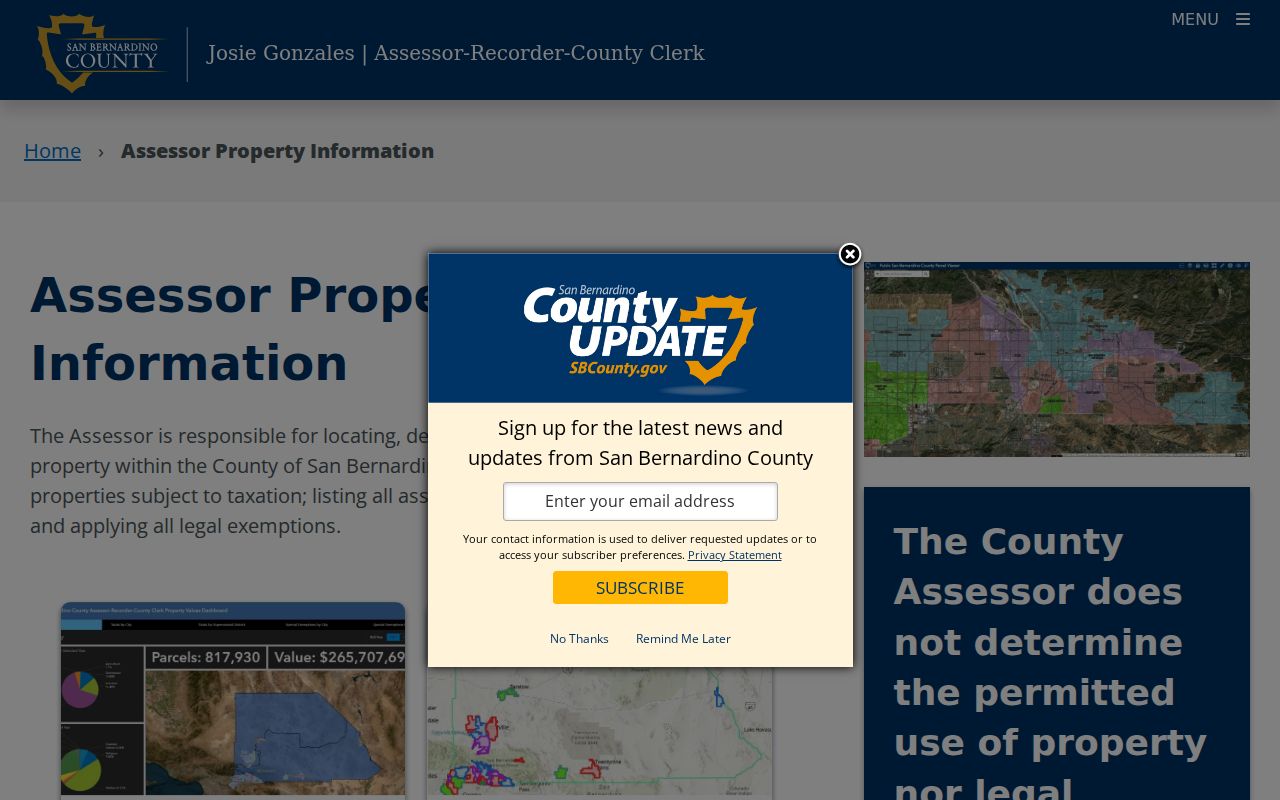
The parcel view is most valuable when its APN and legal-description clues are carried into the recorder search rather than treated as a final answer about a household.
Note: Parcel Access locates a tax parcel and supplies research clues, but the assessor does not determine legal ownership or occupancy.
Browse Fontana Parcels in GIS
Fontana's public GIS service is a geography layer, not a resident roll. A researcher can pan until parcel outlines appear, click a target polygon, and record the APN or jurisdiction clues shown for that layer. The REST MapServer advertises query capability and a maximum of 1,000 records. Layer-specific fields differ, so a query that works for one layer should not be assumed to work for another.
Use GIS to compare a street with city limits, districts, infrastructure, and adjoining parcels. It helps explain why an address may carry a Fontana postal label while a permit or code file belongs to the county. It does not provide a verified list of household members, and a radius or buffer tool was not confirmed. For a block-sized question, pan and click each parcel instead of promising an unverified distance search.
The Fontana public GIS MapServer is the authoritative local layer inventory identified in the research. Save the layer name and query date with each parcel note so later deed or permit work can be repeated.
Carry APNs Through Fontana Deeds
The recorder cannot search property ownership by street address. After Parcel Access supplies a displayed owner clue, search that person or entity as a grantor or grantee in the San Bernardino County Official Records index. Narrow the results by recording date, document type, document number, and the legal description or APN clues. A matching party and parcel trail is stronger than a name alone, especially where trusts, entities, initials, or common surnames appear.
Recorder entries are indexed by document number, document date, document title, and parties as grantors and grantees. The recorder self-service gateway requires its disclaimer step and warns researchers to try spelling variations and other criteria. The public index is like a catalog. It identifies an instrument, but it does not display the instrument image or prove its full legal effect.
- APN
- An assessor's parcel number, the county key used to connect a tax parcel with map and assessment systems.
- Situs address
- The physical location assigned to a parcel on the roll, which may differ from the mailing address.
- Legal description
- The parcel description in a deed, such as a subdivision or lot-and-block reference, that can survive postal wording changes.
- Criss-cross directory
- An address-to-occupant reference, useful for historical households when a verified Fontana volume exists.
Note: A recorded party is evidence of an instrument, not automatic proof that the party owned or occupied the Fontana address on the search date.
Fontana Deed Access: Index or Image
Online and in-person access answer different questions. The recorder's public index is free to search, but the image is not displayed through that public page. The official landing page describes an index from 1925 forward, while county house-research guidance describes online grantor-grantee work from 1958 forward with pre-1958 decade microfilm. Preserve both statements when planning an older Fontana street directory search.
| Route | What is available | Best use |
|---|---|---|
| Online index | Party, date, title and document identifiers; no public image | Find likely instruments and spelling variants |
| Counter inspection | Images at the Hall of Records or High Desert Government Center; maps purchased at the Hall of Records | Read the instrument and compare its legal description |
| Copy request | Online order, mail request, or in-person request through the Assessor-Recorder-Clerk | Obtain a usable copy when the index entry is not enough |
The San Bernardino County Official Records page supplies the current copy instructions and office details. Mail requests use the county copy-request form with a check or money order; the research notes a quoted one-to-two-week mail return. The recorder subscription terms describe a separate image service for users who need batch access. Appointments are strongly encouraged and prioritized, and that subscription is not necessary for ordinary one-record research.
Index-only access is efficient for discovery. An image or counter inspection is the safer choice when the legal description, signatures, parties, or document type must be read rather than inferred.
Fontana Permits, Licenses, and Code
Address records in Fontana become more useful when the jurisdiction is checked first. Development Services can point to permits, project addresses, applicants, contractors, and inspection history where those details are public. Code Compliance can identify closed-case material where disclosure allows it. A focused California Public Records Act request is the fallback for a reasonably described city record that is not posted. County offices handle the parallel record when the postal address lies outside incorporated Fontana.
The city business-license search adds a separate address clue, but the city says the information is self-reported. Its documented controls are:
- Search By: choose Address, Name, or Type.
- Value: enter all or part of the address, name, or type.
- Start-date range: optionally set From and To dates.
For a permit question, call Development Services at (909) 350-7640. Code Compliance uses (909) 854-8020, and business-license questions use (909) 350-7675. Planning at (909) 350-6718 can help distinguish a city project site from an unincorporated county location. City Hall is the central custodian for administrative, permit, and code records, while police reports follow the separate Fontana Police Records channel at (909) 356-7103.
Read a Fontana Reverse Directory
A reverse or criss-cross directory turns an address into a historical occupant clue, which is different from the current parcel roll. The research did not locate an authoritative online shelf list for Fontana publishers, exact annual runs, or reverse-directory years. Lewis Library and Technology Center is the first local reference stop, and the Fontana Historical Society or Fontana Historical Research Library is the specialist fallback. Ask for the specific year, publisher, address section, and abbreviation key before treating an entry as local evidence.
Generic directory conventions can include a surname and given name, spouse notation, residence and business abbreviations, widow notation, and a street address. Those conventions are not a verified Fontana sample. A missing entry can reflect a skipped canvass, a late move, a spelling variant, or an omitted household. The Fontana city directory collection discussion keeps the historical shelf question separate from the modern street-record chain.
Pair any address entry with the deed owner, census household, obituary, or probate record for the same period. That comparison can explain a name change without turning a directory convention into a claim about a living person.
The Fontana ZIP and City-Line Trap
Postal Fontana extends beyond incorporated boundaries. The three core delivery ZIP codes are 92335 for central, south, east, civic, downtown, and industrial areas; 92336 for north Fontana, Heritage, Sierra Lakes, and newer northern development; and 92337 for Southridge. Census geography also shows partial overlap with 91739, centered on Rancho Cucamonga and Etiwanda, and 92316, centered on Bloomington. Those overlap labels orient a search, but they do not establish a city limit or a resident's address.
Verify an individual address through USPS, then compare the parcel with the Fontana boundary layer. A city permit, county permit, business-license file, assessor record, and deed may sit with different custodians when postal and municipal geography diverge. No verified official street-renumbering or ZIP-split year was located, so older street directory work should compare maps and legal descriptions rather than inventing continuity.
Note: A ZIP code can guide an address search, but it is not a parcel boundary, city ward, or proof of Fontana residency.
Why Fontana Ownership Is Not Occupancy
The assessor describes property for taxation and expressly warns that its data is not a legal-ownership determination. A displayed owner clue can be a person, trust, or entity. The situs address locates the parcel, while the mailing address receives assessment correspondence and may point elsewhere. Exemption context can support a research lead, but it does not turn a tax field into proof that someone lives at the property.
The recorder adds another layer of caution. A grantor or grantee appeared in a recorded instrument; the index does not by itself prove current title, consideration, occupancy, or the identity of a same-named person. Voter status is stronger only for the limited question it answers: whether supplied identifying facts match a registration record. California tools require known-person inputs, and qualified voter files are purpose-restricted.
Myth check. A public parcel record is not a household roster. Use it to choose the next custodian and verify the document that supports the specific claim.
Limits on a Fontana Street Directory
A Fontana street directory cannot reliably show people who are not named in property records, household members, minors, utility customers, delivery data, DMV addresses, or protected voters. Membership rosters for community groups are not a public block list. Safe at Home and other confidentiality protections can make a lawful address absent or substituted. A missing name therefore may describe an access limit, not a search failure.
California's privacy rules also narrow voter data, assessor bulk owner-address fields, vital records, and motor-vehicle information. Penal Code §646.9 addresses stalking, and Code of Civil Procedure §527.6 supplies a civil-harassment restraining-order process. Records work should stay tied to family history, property history, civic curiosity, or checking a suspected filing, with the custodian as the final authority.
Lawful personal use. Fontana address records support personal, lawful research. Do not use a street directory to stalk, harass, intimidate, or harm anyone; California law provides criminal and civil remedies for that conduct.
When a needed record is not online, the California Public Records Act permits a request for an identifiable existing record. Agencies generally determine whether responsive disclosable records exist within ten calendar days, with a possible written extension for unusual circumstances. A request should name the record series and date range; an agency need not create a new street roster or answer a question by assembling protected data. Use the California Public Records Act text for the governing framework.