
Fontana Resident Lookup Records Map
A Fontana resident lookup works best as a set of narrow questions. The Assessor can connect a name or entity to a taxable parcel, the recorder can show a named party to a document, and the court can show a case relationship. Vital records confirm events under copy rules. Voter tools verify a supplied voter rather than browse a street. Business and license files add affiliation clues, not proof of residence.
| Record | What It Confirms | Where to Search | Access |
|---|---|---|---|
| Assessor parcel | Name or entity tied to a taxable parcel; situs and mailing distinction | ARC Assessor Property Information | Free map; protected fields possible |
| Recorder index | Named grantor or grantee in a recorded transaction | ARC Official Public Records | 1925-present index; images by order or counter |
| CAP docket | Party name, case, date, type, status, and events | San Bernardino Superior Court CAP | Basic data free; registration and fees for some functions |
| Vital index or certificate | Birth, death, marriage, or dissolution event and possible relatives | ARC or California CDPH | Eligibility and copy fees apply |
| Voter status | Supplied person's registration status and services | California SOS or county elections | Identity inputs or qualified request |
| Business or license | Entity role, business address, credential, or status | Fontana, bizfile, or BreEZe search | Public verification tools |
Start with the strongest fact already known. An address points toward Parcel Access; a case number points toward CAP; an event date points toward ARC or CDPH. A name alone needs spelling variants and a second anchor such as a middle initial, spouse, business, date range, or parcel.
Fontana Resident Lookup: CAP Search Fields
The Superior Court of California, County of San Bernardino Court Access Portal became the primary public court portal in 2022. The CAP case search provides free basic case information. Accept the terms first. Case Information, Case Number, Party/Name Search, case category, Calendar, Search, and Reset are the practical controls. Name and document functions require registration; advanced searches may involve account or credit rules.
| Terms of Service / Accept | Required acknowledgement before searching. |
|---|---|
| Case Number | Most precise route when a known number exists. |
| Party/Name Search | Name field with filters; use spelling variants and known details. |
| Case type or category | Availability varies across civil, criminal/traffic, family, and probate access rules. |
| Calendar | Hearing-calendar search and view. |
| Search / Reset | Runs or clears the query. |
The San Bernardino Superior Court CAP portal keeps the search centered on a case or party record rather than a general Fontana resident list.
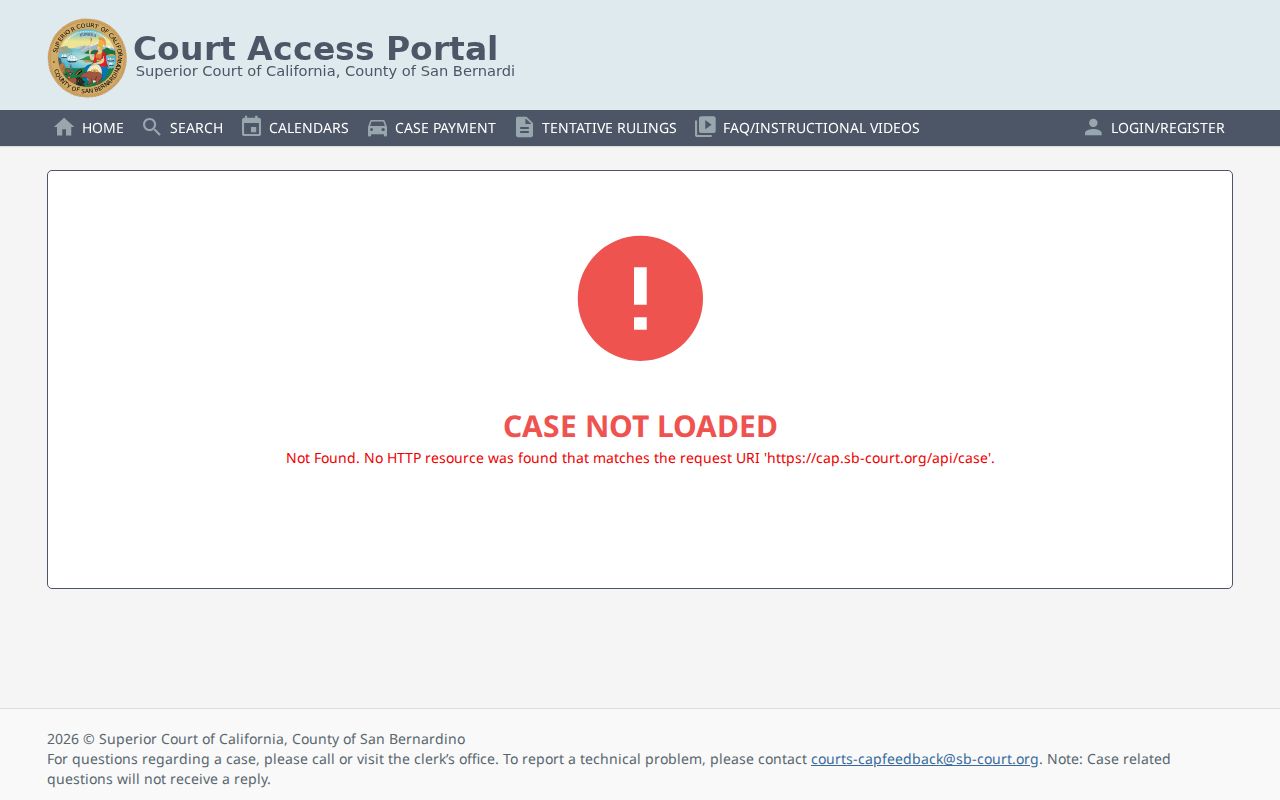
The CAP image shows the focused search entry point; access rules govern results and document images.
Remote civil images cost $0.50 per page. The court's online-services page explains public case-information and document routes. Federal cases belong in PACER, not CAP. Pre-1998 data is limited, and older or off-site files may take up to a week. The clerk at the filing or hearing district is the in-person fallback; a copy request should include names, case number, and known filing or hearing details.
A CAP result commonly returns:
- case number and caption or party names;
- filing date, category, and current status;
- events and hearing entries;
- document register and, where available, purchasable images;
- access limits for sealed, juvenile, adoption, and confidential matters.
Two Anchors for a Fontana Resident Lookup
One record rarely proves that a search result belongs to the intended resident. An assessor owner is not necessarily an occupant. A recorder party is tied to an instrument, not a residence. A voter match confirms registration, not real-time physical presence. A court caption can merge two people with the same name. The safest Fontana resident lookup keeps two independent anchors together.
- Write the name in full, then add an address or APN, middle name, spouse, business, date range, or case number.
- Search ARC parcel information or approved voter verification, then save the exact clue and date.
- Run CAP Party/Name Search with spelling variants and compare county, dates, case type, and identifiers.
- Use a vital index, license, business filing, newspaper, or probate clue to test the match.
- Ask the source custodian to correct a wrong record; do not ask another portal to overwrite it.
- Docket
- The court's running case record, including filings, events, hearings, and status entries.
- Index versus image
- An index summarizes a record; an image is the filed document and may require a purchase or counter request.
- Certified copy
- A custodian-issued copy that carries formal certification, unlike an informational copy.
That distinction keeps a resident lookup useful for genealogy, reconnecting, estate work, and civic research without turning a clue into proof.
Fontana Vital Records Confirm Events
San Bernardino ARC and California Department of Public Health both serve vital-record needs. Birth and death informational copies may be available to the public, while authorized certified copies require the statutory relationship, sworn statement, and identity path. Public marriage records have informational and authorized routes. Confidential marriage copies are limited to a party or court order.
| Birth | CDPH 2026 fee $31; use VS 111 and follow copy eligibility. |
|---|---|
| Death | CDPH 2026 fee $26; use VS 112 and distinguish informational from authorized. |
| Public marriage | CDPH 2026 fee $19; use VS 113A where appropriate. |
| Dissolution | CDPH 2026 fee $18 for a certificate, not the full court decree. |
VS 111, VS 112, and VS 113A ask for applicant contact details, relationship and purpose, names, event date and place, copies, signature, and date. Mail requests use the signed form, fee, and required identity or notarial materials. The CDPH vital-record fee schedule is the current fee check. Health and Safety Code sections 103525-103526 control certified-copy eligibility. California has no simple rule that every modern certificate opens after a set number of years.
Fontana Resident Voter Status Checks
California My Voter Status is an identity-verification tool, not a browseable Fontana voter directory. The search asks for first name, last name, date of birth, and a California driver license or ID number or the last four digits of a Social Security number. Those inputs are designed to find a supplied voter. Registration information and participation history are governed by Elections Code sections 2188 and 2194, while sensitive identity fields and signatures remain confidential.
The California voter-status page is the right first stop for a person who can supply the identity facts. A qualified file request is different: the Secretary of State voter-file rules describe a statewide file at $100, or a request for up to ten named voters at $30 each, capped at $100. The request requires an approved electoral, governmental, scholarly, journalistic, or political purpose. Safe at Home and confidential-voter protections can remove an address from ordinary results.
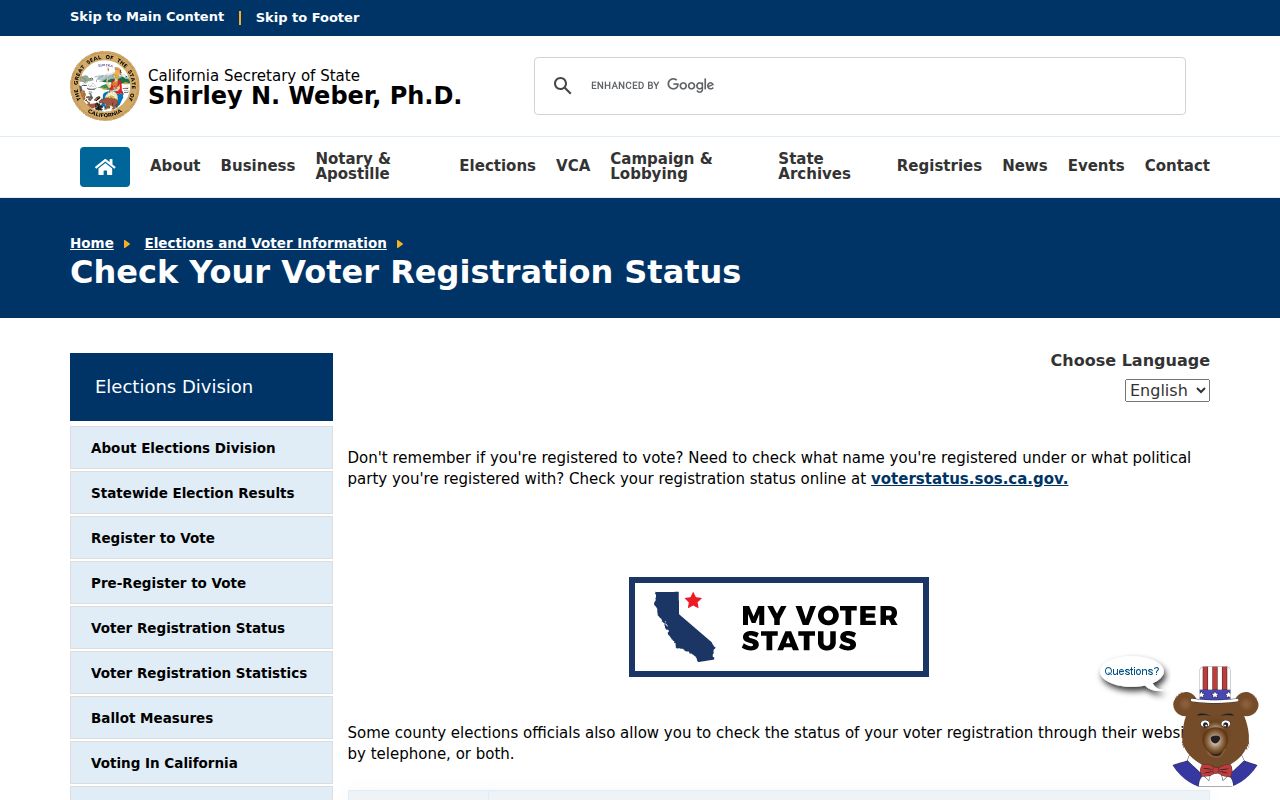
The voter-status image shows why a known-person check differs from a street search. A match supports registration status, not current occupancy or a complete list of Fontana residents.
Fontana Probate and Resident Family Trails
A one-person search changes shape when the goal is an heir, birth parent, former classmate, or deceased relative. Probate dockets and public filings can identify a decedent, personal representative, heirs, and recorded affidavits or deeds. For a birth-parent question, use California's official adoption information and consent mechanisms with the court process; adoption files are confidential and are not a public name index.
For a former classmate, verified school yearbooks and library alumni material can establish a year and name before newspapers or obituary sources add context. A business-owner question can pair a Secretary of State entity record, Fontana business license, and county fictitious-business-name filing. Each trail has a custodian and a stopping point. CAP can point to a probate file, but the clerk's file and copy rules control what can be read.
Custody and registry questions use separate official tools. The San Bernardino County inmate locator is current-custody focused and may require middle-name variants; California CIRIS uses a last name or CDCR number, and California's Megan's Law registry has statutory search limits and an anti-misuse notice. These results are status clues, not proof of a Fontana residence.
Fontana Business and Resident License Clues
Business and professional records can help separate two people with the same name. Fontana's business-license search accepts Address, Name, or Type, with an optional start-date range. The city's records are self-reported. Secretary of State bizfile can add entity status, jurisdiction, agent, and filings; a county fictitious business name can connect a trade name to a filed registrant. These are affiliation clues, not a resident roll.
The California BreEZe professional-license search provides public name and license verification. It can show board, license type or number, status, dates, and discipline links as available. The image below illustrates a professional lookup by name.
Fontana business licensing also gives a local contact path: Planning at (909) 350-6718 can clarify city or unincorporated jurisdiction, and Business Services is (909) 350-7675. A license address may be a premises or mailing address, not the license holder's residence.
Fontana Resident Privacy: DROP, Safe at Home
California privacy controls change what a resident lookup can lawfully reveal. The CCPA, Civil Code sections 1798.100 and following, gives rights to know, access, delete subject to exceptions, correct, opt out of sale or sharing, and limit sensitive-information use. Government-record information that is lawfully available is excluded from CCPA personal information, so deleting a broker profile does not erase a deed or court source.
Data brokers are also covered by Civil Code sections 1798.99.80-1798.99.89 and the DELETE Act. Individual opt-outs still use each company's privacy, access, or deletion process; retain confirmation and report a broken mechanism to the Attorney General. DROP opened in January 2026. A Californian verifies residency, creates an encrypted profile with chosen identifiers, and sends one deletion or non-sale request to registered brokers. The Attorney General reported 225,000 signups in under six weeks and more than 500 brokers in scope; deletion duties began August 1, 2026.
Safe at Home, under Government Code sections 6205-6216, is a free four-year renewable program that supplies a substitute mailing address, mail forwarding, service-of-process support, confidential voter registration, and related protections for qualifying participants. The California Attorney General's Safe at Home explanation describes the address-protection limits. It does not erase old records. Under section 6209.5, a participant can request substitute mailing information on selected property documents, although a legal description can still reveal the parcel.
Lawful Boundaries for a Fontana Resident Lookup
California's Public Records Act, Government Code sections 7920.000-7931.000, covers identifiable existing records. An agency generally has ten calendar days to determine whether responsive disclosable records exist, with a possible fourteen-day extension for unusual circumstances. Inspection is normally free, while copies can carry direct duplication costs. A request should describe a record series and date range; an agency need not create a new resident list or disclose exempt personal and security material.
Courts are different. Judicial administrative records use California Rule of Court 10.500, and the court administrative-record request route is not a substitute for a case-file request. For an older file, the court's public file-viewing instructions describe online, counter, and off-site options. Case access follows court rules and statutes. Sealed cases, juvenile matters, adoptions, confidential family information, protected voters, DMV data, assessor bulk owner fields, confidential marriages, and Safe at Home addresses can stop a resident lookup. A narrow request to the custodian is the fallback.
Commercial people-finder services are a category of compiled public and commercial data. They can be stale, merge identities, or omit protected people, and they are not official evidence or a way around a custodian's privacy rules.
Lawful use. A Fontana resident lookup is for personal, lawful research. Do not use a record to stalk, harass, intimidate, or harm another person, and stop when privacy controls close the trail.