
Fontana's Historical City Directory Shelf
Fontana's city directory collections are distributed among local-history shelves, county archives, state resources, and genealogy databases. No authoritative online shelf list was located for Fontana publishers, verified annual runs, reverse-directory years, or a last printed edition. That gap matters. A catalog record, a library search result, or a generic directory guide cannot establish that a particular Fontana volume exists. Treat every year and publisher as a question to verify with the custodian.
| Collection | Years | Where Held | Access |
|---|---|---|---|
| Fontana city-directory volumes | Publisher and year runs unconfirmed | Lewis Library and Technology Center, 8437 Sierra Avenue | Ask reference staff; no verified online shelf list |
| Reverse or criss-cross directories | Exact years unconfirmed | Lewis Library and Fontana Historical Society | Request an address-focused search |
| County historical records | Probate 1853-1926; Great Registers 1866-1908 | San Bernardino County Historical Archives | Archive inquiry, not a city-directory run |
| Census companions | 1790-1950 public; 1960 scheduled 2032 | National Archives, partner databases, library access | Release-rule access |
The most accurate request names the place, record type, and span sought: Fontana or Rosena, alphabetical or address order, and a particular decade. Ask whether the volume is on open shelves, on microfilm, in a restricted local-history collection, or available only through staff research. A negative answer should mean “not confirmed in that collection,” not “no residents lived there.”
Fontana's Library City Directory Trail
Lewis Library and Technology Center opened in 2008, and city material describes it as the largest library facility in San Bernardino County. Its reference and local-history role makes it the first call for a Fontana city directory inquiry. Ask about newspapers, yearbooks, licensed genealogy databases, local-history files, and staff help with a name or address. No published hours or verified shelf list appear in the research record, so confirm current access before traveling.
The Fontana Historical Society and Fontana Historical Research Library are the specialist fallback when a city directory question turns into local history. The San Bernardino County Library system, County Archives and Museum, California State Library and Archives, FamilySearch, licensed newspaper databases, Chronicling America, the National Archives, and Library of Congress Sanborn maps form the wider chain. California historical birth and death indexes chiefly cover 1905-forward, with coverage that varies by index product. Fontana-specific Sanborn sheets were not confirmed. Each repository may hold a different piece, so record the exact title, year, page, and search path returned.
Great Registers in Fontana Directory Research
Great Registers add a vivid historical layer to a Fontana city directory search. San Bernardino County Historical Archives holds Great Registers from 1866-1908. Depending on the entry, they can include occupation, age, height, physical description, and naturalization information. Those details can distinguish two men with similar names and can suggest a place in a life story when a city directory is missing.
They are not resident rolls and do not replace a directory. Use them as a dated name clue, then compare the result with census households, newspapers, recorded documents, or probate. The archive also reports probate from 1853-1926, births and deaths beginning in 1873, and marriages from 1853. Research questions can go to ARC-DLRecArchive@arc.sbcounty.gov or (909) 387-1001.
Read a Fontana City Directory Entry
No digitized, authoritative Fontana directory page was available for inspection. The fields below are generic directory conventions collected in the research, not a verified description of a local volume. Read the key in the specific edition before treating an abbreviation, owner mark, or spouse notation as a Fontana fact.
| Name | Surname and given name; a spouse may appear in parentheses. |
|---|---|
| Trade or role | A trade or public role, if that edition records it. |
| Address | House number and street, with “r” for residence and “b” for business in generic examples. |
| Ownership mark | Some runs distinguish an ownership status; Fontana symbols are unconfirmed. |
| Widow notation | A widow marker may connect a name to a spouse, but its local form must be checked. |
- Criss-cross directory
- An address-order section that can move from a street and number to a listed occupant.
- Householder index
- An alphabetical name list centered on the person or household head selected by that edition.
- Abbreviation key
- The volume's legend for short forms and marks; check it before reading every entry.
Fontana Directory Marks Need Local Proof
A city directory entry can look precise while still hiding a broad editorial choice. One edition may list a householder, another may list a spouse, and a third may omit a household altogether. Because the Fontana publisher, exact run, and reverse section are not verified, the safest research path is a direct holdings inquiry.
- Ask Lewis Library for the title, publisher, years held, order of the volume, and any abbreviation key.
- Ask whether an address-order or criss-cross section is present for the year under review.
- Take an unconfirmed year to the Fontana Historical Society and Historical Research Library for a second local check.
- Use the San Bernardino County Library, County Archives and Museum, or California State Library and Archives for nearby historical context.
- Record the source and page before pairing the entry with census, newspaper, deed, or probate evidence.
That path preserves a useful distinction: a generic sample explains how to read a kind of book, while a verified scan proves what a Fontana city directory actually contains.
Rosena to Fontana City Directories
Place names set the search frame. San Bernardino County formed in 1853, but earlier Fontana-area research may sit in Los Angeles County. The agricultural and railroad settlement was known as Rosena before 1913, became Fontana after the rename, and incorporated in 1952. A directory search that uses only the modern city name can miss a household, especially when an index follows the name used at publication.
| Before 1853 | Check Los Angeles County when the record predates San Bernardino County formation. |
|---|---|
| 1853 onward | Use San Bernardino County archives and local repositories for county-era material. |
| Before 1913 | Search Rosena as the place label for the Fontana area. |
| 1913 to 1952 | Search Fontana and compare the county, railroad, and agricultural context. |
| 1952 onward | Include incorporated Fontana records alongside county sources. |
A.B. Miller's early development of about 17,000 acres, Kaiser Steel's arrival in 1942, and the later mill closure and speedway site help explain why address context changed. The City of Fontana history timeline is a useful place-name check, not a substitute for a directory page.
Fontana Census Images Anchor Directory Years
The National Archives census research guidance explains which federal population schedules are public and how the 72-year release rule works. The 1790-1950 census records are public; the 1960 census is scheduled for release in 2032. A census household can supply names, relationships, ages, occupations, and later address clues that give a city directory entry a firmer time frame.
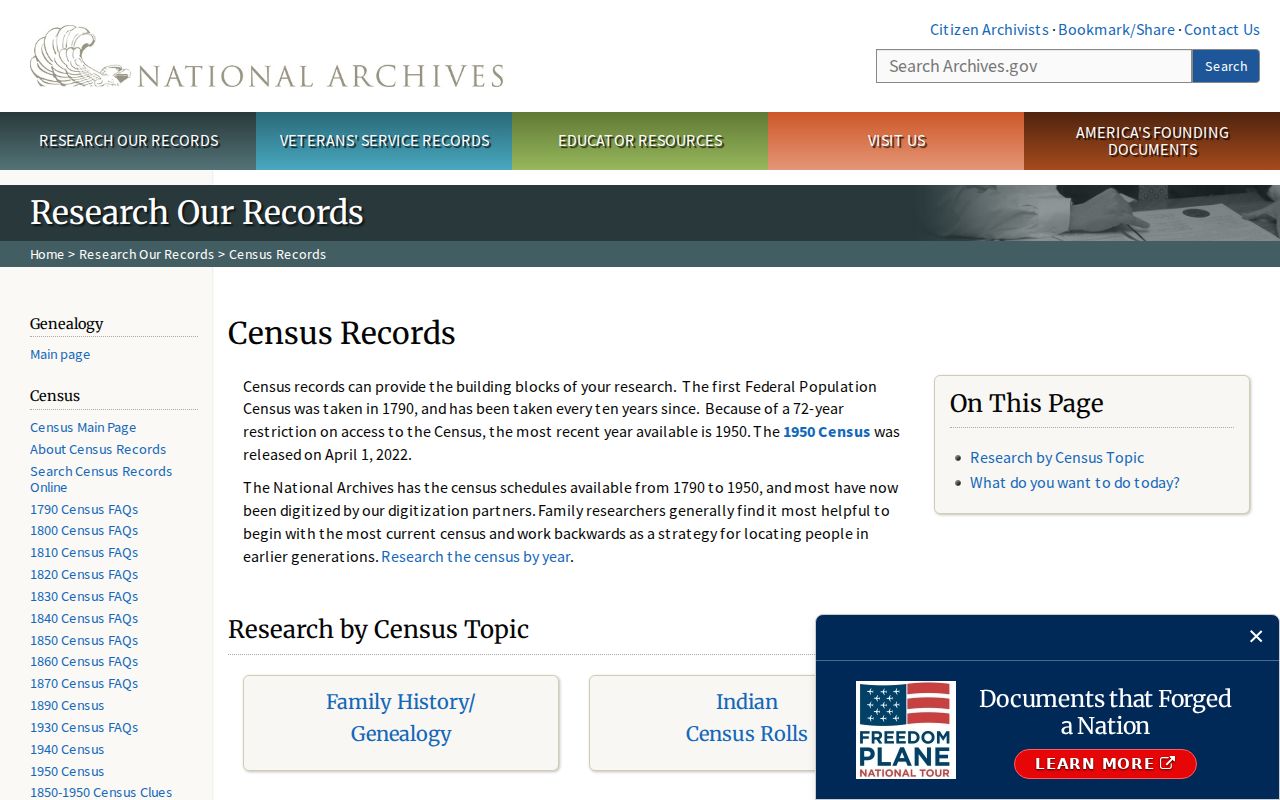
The census research image points to the federal release schedule and access path. Pair a public census year with the closest directory edition, then mark the years between them as inference rather than a continuous record.
Pair Fontana Directory Occupants With Owners
A directory occupant and a property owner answer different questions. Use the address-order section, when a verified volume has one, to identify a listed occupant. Then compare the parcel and legal description with the Assessor-Recorder-Clerk. The San Bernardino County official-records guidance explains that the recorder index is organized by document number, date, title, and grantor or grantee, not by street address.
The online recorded-document index reaches 1925-present, while county house-research guidance describes 1958-present online grantor/grantee work and pre-1958 microfilm. Preserve that discrepancy in notes. Images are not displayed through the public index; inspect at the Hall of Records or High Desert Government Center, or order a copy. A recorded party is evidence of a transaction, not proof that the person lived at the address.
When a directory name needs current identity checks rather than historical reading, the Fontana resident lookup workflow supplies the separate court, vital, and voter cautions.
Note: A reverse-directory address can identify a listed occupant, but only independent records can test whether that person owned or occupied the property.
Fontana Directory, Obituary, and Probate Clues
When a city directory stops listing a household, newspapers and obituaries can supply the missing link. Lewis Library, the San Bernardino County Library system, licensed newspaper databases, and Chronicling America are documented research channels. Search the surname, address, spouse, club, school, and cemetery clue rather than relying on a single obituary phrase. No authoritative Fontana obituary index or city-run cemetery database was located.
Probate can close a family trail. San Bernardino County Historical Archives reports probate from 1853-1926, while Superior Court files can provide later probate dockets and public filings. Use the decedent, personal representative, heirs, and recorded deed clues together. Fontana Heritage Center, 7350 W. Liberty Parkway, (909) 349-6968, is a community contact, but its official information does not establish archival holdings. No authoritative membership or alumni roster was verified. The archive's email, ARC-DLRecArchive@arc.sbcounty.gov, and phone, (909) 387-1001, give a precise fallback when a catalog or index does not answer the question.
Trace Fontana Directory Households Through Time
A careful household trail moves in small, dated steps. Start with a known name or address, keep the original spelling, and record what each source actually says. Directory pages can show a household between census years, while the census can test relationships and ages. A move, death, omission, or name variant can look the same until another source separates them.
- Choose a known census or address year, then ask for the closest verified Fontana or Rosena directory edition.
- Follow the name through each edition located, recording street, number, spouse notation, occupation, and any editorial mark.
- Check the reverse or criss-cross section for the address, but label its occupant as listed rather than proven owner.
- Compare the nearest public census household and use county recorded documents, when dates fit, to test the owner trail.
- Finish with newspapers, obituaries, probate, or archive records when a person disappears or an heir needs confirmation.
A missing annual entry may reflect a move, late canvass, spelling variant, omission, or death. It is not evidence that a household was absent from Fontana. The strongest conclusion states the year, source, page, and limits of the match.
Note: Place-name changes, unverified directory years, and the census release schedule should remain visible in every family-history research log.